




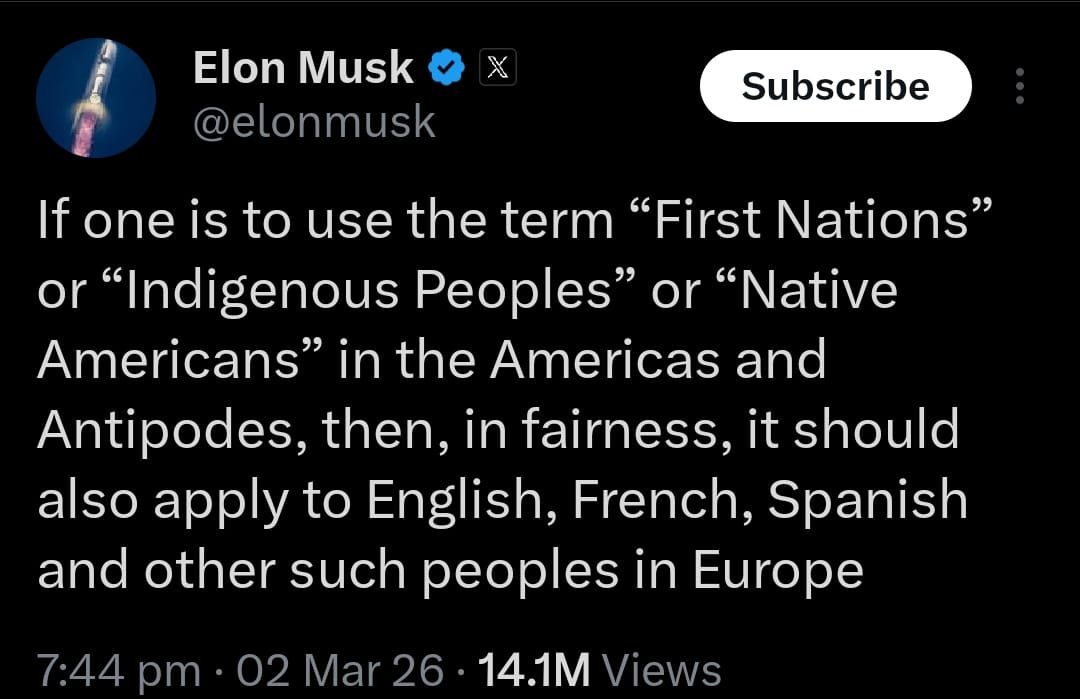
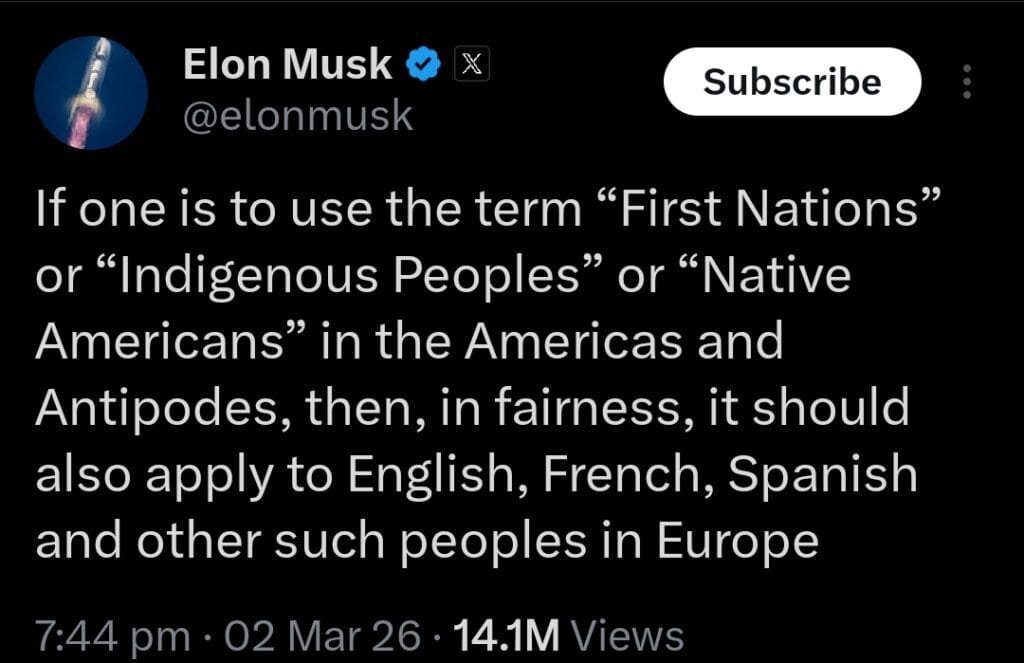
In the digital age, a single observation can ignite a firestorm of historical and philosophical debate. When Elon Musk suggested that the terms “First Nations” or “Indigenous” should, in fairness, apply to the English, French, and Spanish in Europe, he touched a nerve that spans centuries of colonial history.
On the surface, the logic seems airtight: if being “Indigenous” means your ancestors were the first to inhabit a land, then surely the people who evolved their language, culture, and architecture in Europe for millennia qualify. However, beneath the surface of this “fairness” argument lies a complex web of legal definitions, power dynamics, and the scars of global expansion.
To understand who is truly “Indigenous” and who is simply “native,” we must look beyond DNA and into the heart of how modern nations were built.
Part I: The Etymology of Belonging
Before we can settle the political debate, we must define our terms. In common English, “Native” and “Indigenous” are often used as synonyms, but in the realms of law and sociology, they serve very different purposes.
1. Defining “Native”
The word “native” comes from the Latin nativus, meaning “born.” In its most basic sense, it is a geographic marker.
- The Biological Native: This refers to someone whose ancestry traces back to a specific region. A person of Han Chinese descent is native to East Asia; a person of Zulu descent is native to Southern Africa.
- The Situational Native: In modern parlance, we often use “native” to describe where someone was born and raised. You can be a “native New Yorker” even if your grandparents immigrated from Italy.
2. Defining “Indigenous”
The term “Indigenous” is far more specific. Derived from the Latin indigena (sprung from the land), it has evolved into a political and legal status.
The United Nations and the International Labour Organization (ILO) do not have a strict, one-sentence definition of Indigenous Peoples, but they use a set of criteria:
- Self-identification as indigenous at the individual level and accepted by the community.
- Historical continuity with pre-colonial and/or pre-settler societies.
- Strong link to territories and surrounding natural resources.
- Distinct social, economic, or political systems.
- Maintenance of distinct languages, cultures, and beliefs.
Part II: The “European” Argument
The crux of the recent debate is whether Europeans—specifically the English, French, and Spanish—should be classified as Indigenous.
The Case for “Yes”
Proponents of this view argue that the English did not “spawn” from nowhere; they are the result of thousands of years of European development. The English language, though influenced by Norse and French, is a product of that specific island. Their folklore, their ancient sites (like Stonehenge), and their genetic markers are tied to that soil. By denying them the label of “Indigenous,” some argue we are creating a “hierarchy of victimhood” where only those who were conquered are allowed to claim a deep connection to their land.
The Case for “No”
The counter-argument is rooted in sovereignty. The English are not a marginalized minority in England; they are the state. They have the power to protect their own language, celebrate their own holidays, and control their own land.
- The Power Gap: In the Americas, “Indigenous” status is used to protect groups from being swallowed up by a dominant, external culture. In England, the English are the dominant culture.
- The Colonial Engine: The English, French, and Spanish were the primary drivers of the colonial era. To label the colonizer with the same term used to protect the colonized is seen by many historians as a “category error” that erases the specific struggles of displaced peoples.
Part III: The “Blue-Water” Thesis and International Law
Why doesn’t international law recognize the French as Indigenous? It comes down to the Salt-Water Thesis (or Blue-Water Thesis).
Following World War II, the UN sought to decolonize the world. They defined a colony as a territory that was geographically separate from the country administering it (usually separated by an ocean, or “blue water”).
- Internal vs. External: Because the French reside in France and govern themselves, they are seen as a sovereign nation-state.
- Indigenous Exceptions in Europe: Interestingly, Europe does have recognized Indigenous groups. The Sámi people of the Arctic (Norway, Sweden, Finland, Russia) are recognized because they are a distinct group whose traditional lands were divided by the borders of modern nation-states, and they have historically been marginalized by those states.
Part IV: The Science of Migration (The “Who Was There First” Problem)
If we use a strict “who arrived first” metric, the definition of Indigenous becomes even muddier. Human history is a story of constant movement.
- The Americas: Humans crossed the Bering Land Bridge roughly 15,000 to 20,000 years ago. While they were the “first” in the sense of modern history, different tribes frequently displaced one another over millennia.
- The United Kingdom: The “English” are a blend of Celts, Romans, Anglo-Saxons, Vikings, and Normans. Who among them is the “original”? The Celts displaced earlier Neolithic peoples; the Anglo-Saxons displaced the Celts.
This is why the UN definition relies on continuity rather than just arrival time. It’s not about who stepped off the boat first in 10,000 BC; it’s about who was there when the modern, dominant state was formed and whether that group was allowed to keep their way of life.
Part V: Why This Matters for the Future
The debate over these words is actually a debate over resources and rights.
- Land Rights: Indigenous status often grants specific legal claims to ancestral lands and natural resources.
- Cultural Preservation: It provides a framework for protecting languages that are in danger of extinction.
- Political Voice: It allows groups to have a seat at the table in international forums like the UN.
If everyone is “Indigenous,” the term loses its legal teeth. If the term is too narrow, it risks ignoring the deep, ancestral ties that all humans feel toward their homelands.
Conclusion: A Matter of Perspective
Elon Musk’s comment highlights a growing cultural fatigue with language that feels exclusionary. However, the distinction between “Native” and “Indigenous” remains a vital tool for human rights.
The English are native to England. They are the “First Nation” of their land in a chronological sense. But they are not “Indigenous” in the political sense because they possess the ultimate privilege: sovereignty. They do not need a special UN designation to protect their right to speak English in London.
The terms we use for “belonging” are not just descriptions of the past—they are tools we use to navigate the power structures of the present.