






The Métis are a distinct Indigenous people in Canada, recognized as one of the three Aboriginal peoples along with First Nations and Inuit. They are not simply people of mixed Indigenous and European ancestry; they are a people with a unique history, culture, language, and political identity that developed in the Canadian Prairies.
The core of the Métis Nation originated in the 18th and 19th centuries, primarily from the relationships between First Nations women (mostly Cree, Ojibwe, and Saulteaux) and European fur traders (mostly Scottish and French-Canadian).
Note on Terminology: The term “Métis” with a capital ‘M’ specifically refers to the distinct people of the historic Métis Nation in Western Canada. The term “métis” with a lowercase ‘m’ is sometimes used in a broader sense to describe people of mixed Indigenous and European ancestry in other parts of the world, but this is a separate concept.
Key Aspects of Métis Identity and Culture
- Language: Michif
The Métis language,Michif, is a unique fusion and is considered an endangered language. It typically combines:
· Nouns and adjectives: from French (e.g., la fam, the woman)
· Verbs and grammar: from Cree or other Algonquian languages (e.g., kiwétam, he knows it)
There are several dialects of Michif,with some drawing more from Ojibwe or French.
- Symbolism: The Métis Flag and Sash
· The Infinity Flag: The most famous Métis flag is a blue or red field with a white infinity symbol (∞). The infinity symbol represents the coming together of two distinct cultures (European and First Nations) to create a new, eternal people.
· The Sash (L’assomption Sash or Ceinture fléchée): A vibrant, woven belt worn around the waist. Historically, it had many practical uses for voyageurs (as a rope, towel, or emergency saddle blanket). Today, it is the most prominent symbol of Métis identity, worn at cultural events and ceremonies.
- Music and Dance
Métis culture is known for its lively fiddle music and jigging.The “Red River Jig” is a traditional dance that combines First Nations footwork with European jig and reel steps. Fiddle music is a central part of Métis social gatherings. - Homeland and History
The Métis homeland is centered in theRed River Valley (in present-day Manitoba). In the early 1800s, they established a distinct society with its own laws, economy, and way of life based on the buffalo hunt.
Key Historical Events
- The Red River Resistance (1869-1870)
When Canada sought to take over the Hudson’s Bay Company’s lands without consulting the local inhabitants,the Métis, led by Louis Riel, formed a provisional government to negotiate terms for joining Canada. This resulted in the Manitoba Act of 1870, which created the province of Manitoba and promised Métis land rights. However, the Canadian government failed to uphold these promises, leading to the dispersal of many Métis westward. - The North-West Resistance (1885)
Métis grievances over land and rights continued as they moved into what is now Saskatchewan.They invited Louis Riel back from exile to lead their negotiations. The situation escalated into an armed conflict between Métis and their First Nations allies and the Canadian government. The Métis were defeated at the Battle of Batoche. The aftermath was tragic:
· Louis Riel was executed for treason.
· This event entrenched a legacy of marginalization and discrimination for the Métis for generations.
Métis Today
- Governance
The Métis have their own governance structures.The Metis National Council is the national representative body, and its governing members include provincial organizations like:
· Metis Nation of Ontario (MNO)
· Manitoba Metis Federation (MMF)
· Metis Nation–Saskatchewan (MN–S)
· Metis Nation of Alberta (MNA)
· Metis Nation British Columbia (MNBC)
These organizations provide services, advocate for rights, and manage citizenship.
- Land and Rights
Métis rights,including hunting and harvesting rights, have been a major focus of legal battles. The landmark Powley case (2003) in the Supreme Court of Canada affirmed that Métis are a distinct rights-bearing people under Section 35 of the Constitution Act, 1982. - Citizenship
Métis citizenship is not based solely on ancestry.To be a citizen of a Métis governing member, an individual must:
· Self-identify as Métis.
· Provide evidence of a historic connection to the Métis Nation (e.g., ancestry to a Métis community).
· Be accepted by the modern Métis Nation community.
- Population and Revival
According to the 2021 Census,over 624,000 people in Canada identify as Métis. There is a powerful cultural and political revival happening, with growing pride in language, music, art, and the reclamation of their unique place in Canadian history.
The Métis are a resilient, distinct Indigenous nation born from the meeting of worlds. From their origins in the fur trade to their struggles for rights and their vibrant cultural revival, they hold a unique and essential place in the story of Canada.
Métis knowledge systems and Indigenous beliefs.
Core Philosophical Foundation: Wahkootowin
The most central concept is Wahkootowin (a Cree-derived word meaning “kinship” or “being related”). This is not just about blood relations; it’s a worldview that emphasizes:
· Interconnectedness: All things—people, animals, plants, the land, the spirit world—are related and exist in a web of reciprocal relationships.
· Responsibility: Because everything is related, humans have a responsibility to act with respect, maintain balance, and honour their obligations to all creation.
· Community over Individual: The well-being of the collective (the family, the community, the land) is paramount.
This principle of Wahkootowin directly shaped Métis laws, governance, and daily life.
Key Characteristics of the Métis Knowledge System
- Practical and Adaptive Knowledge (“The Original Knowledge Economy”)
The Métis knowledge system is profoundly practical,developed through centuries of living on the land. It is not theoretical but applied and adaptive.
· Ecological Knowledge: They possessed an encyclopedic knowledge of the Prairie ecosystem.
· Buffalo Hunt: They knew buffalo migration patterns, could predict weather for the hunt, and used every part of the animal (food, clothing, tools, shelter)—a practice reflecting respect and non-waste.
· Medicine: They developed a rich pharmacopoeia of plant-based medicines, combining First Nations herbal knowledge with European remedies. Knowledge of which plants to use for teas, poultices, and healing was essential.
· Navigation and Survival: Expert knowledge of rivers, trails, and weather patterns was critical for their role as voyageurs and guides.
- Oral Tradition and Experiential Learning
Knowledge was passed down orally through stories,songs, and direct experience.
· Stories and Aaniskootaapaan (Legends): Elders taught history, moral values, and survival skills through stories. These often featured characters like Wiisagejaak (the trickster figure, similar to Nanabozho in Ojibwe culture), who taught lessons about cleverness, folly, and the consequences of actions.
· Learning by Doing: Children learned to jig, trap, hunt, bead, and prepare food by watching and participating alongside elders and family members.
- A Blended Spiritual Belief System
Métis spirituality is a unique blend,not a simple fusion. It typically incorporates:
· Catholicism: Due to the influence of French-Canadian and Scottish Catholic fur traders, many Métis adopted Catholicism. However, they often practiced it in a way that incorporated Indigenous spirituality. The Virgin Mary, for example, was sometimes associated with the life-giving and protective forces of the Earth.
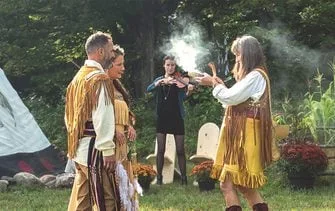
· Indigenous Spirituality: A deep belief in the spirit within all living things (animism), respect for animal spirits, and the importance of dreams and visions remained strong. Ceremonies like the pipe ceremony and smudging are practiced by many Métis today as part of their spiritual reclamation.
This blending can be seen in their folk art, where floral patterns (inspired by Indigenous designs) are used to decorate Catholic items like altar cloths.
Expression of Knowledge and Belief
- Laws and Governance: The Laws of the Prairie
The Métis developed a sophisticated system of laws based on Wahkootowin,which was most evident in the organization of the Buffalo Hunt. This was not a chaotic free-for-all but a highly disciplined operation governed by a council of elected captains (Les Capitaines de la Chasse). Their rules included:
· No hunting on Sundays (reflecting Catholic influence).
· No running the buffalo before the signal was given (ensuring a fair and effective hunt for the whole community).
· Strict penalties for disobedience, protecting the common good.
This system demonstrated their belief in order,fairness, and collective responsibility.
- Material Culture as Embodied Knowledge
The beautiful and functional items created by the Métis are physical manifestations of their knowledge system.
· Beadwork: The distinctive floral beadwork patterns are not just decorative. They represent knowledge of local plants, a connection to the land, and stories passed down through generations. The patterns are often unique to families or communities.
· The Red River Cart: An ingenious invention perfectly adapted to the Prairie environment. Its large, spoked wheels could traverse muddy terrain, and it was made entirely of wood (with no metal nails) so it could be repaired on the trail and even floated across rivers. Its design embodies practical problem-solving and deep understanding of the landscape.
Modern Context and Revitalization
Like other aspects of their culture, Métis knowledge systems were suppressed by colonial policies. Today, there is a powerful movement to revitalize this knowledge:
· Elder Knowledge: Elders are recognized as the keepers of language, stories, and traditional practices.
· Land-Based Education: Programs are taking youth onto the land to learn traditional skills like trapping, fishing, and plant identification directly from Knowledge Keepers.
· Academic Recognition: There is a growing effort within universities to respect and incorporate Indigenous Knowledge, including Métis knowledge, as a valid and essential way of understanding the world.
Métis mythology and storytelling.
The Core Influence: The Trickster
The most prominent figure in Métis mythology is the Trickster, who embodies creativity, chaos, humor, and lessons about how to (and how not to) behave. The Trickster is primarily known by two names, reflecting the two root cultures:
- Wiisagejaak (or Wiisakejak): This is the Cree name for the Trickster. He is a central figure in many stories.
- Nanabozho (or Nanabush): This is the Ojibwe name for a similar, often more benevolent, cultural hero and trickster.
In Métis stories, the Trickster is a complex character who:
· Explains the world: Stories often explain how certain natural features came to be.
· Teaches lessons: His foolishness, greed, or arrogance often leads to trouble, teaching listeners about the importance of wisdom, humility, and community.
· Provides humor: The stories are entertaining, full of slapstick and clever wordplay.
Key Figures and Beings
Besides the Trickster, Métis mythology includes a cast of other characters from Algonquian (Cree/Ojibwe) traditions, often blended with elements from French-Canadian and Catholic folklore.
- The Rooftop Bogeyman: The Chenoo (Loup-Garou)
· This is a fascinating example of fusion. The Chenoo is a fearsome, cannibalistic ice giant from Mi’kmaq and other Eastern Woodlands legends. The French-Canadian settlers had their own legend of the Loup-Garou (a werewolf or shapeshifter cursed for committing a sin, like not attending Mass for a year).
· In Métis communities, especially in the Red River area, these figures merged. Parents would warn misbehaving children that “the Chenoo will get you!” or that “the Loup-Garou is on the rooftop!” This figure served as a bogeyman to enforce social rules, blending Indigenous and European concepts of a terrifying supernatural punisher.
- Little People: Maymaygwayshiuk
· These are small, magical, dwarf-like spirits who live in rocks, cliffs, and near water. They are mischievous but can also be helpful to humans if shown respect. Belief in the “Little People” is very strong in many Indigenous cultures, and it remained a vibrant part of the Métis worldview, connecting them to the spirit of the land.
- Spirit Animals
· Like their First Nations relatives, the Métis hold certain animals as spiritually significant. The buffalo is paramount, not just as a source of food but as a sacred relative whose sacrifice made life possible. Other animals like the wolf (for hunting and family), the bear (for strength and medicine), and the horse (for freedom and mobility) feature prominently in stories and symbolism.
Unique Métis Mythological Themes
Métis mythology isn’t just a preservation of old tales; it evolved to reflect their new identity.
· The Buffalo Hunt as a Sacred Event: The organization and laws of the buffalo hunt were not just practical; they had a spiritual dimension. The success of the hunt was seen as dependent on maintaining harmony with the animal spirits and following the communal rules laid down by the hunt captains. Disrupting the hunt was not just a breach of protocol; it was a spiritual transgression.
· The Red River Cart and the Fiddle: While not “mythological” in the classic sense, these objects take on a legendary, almost magical quality in Métis stories. They symbolize the ingenuity, mobility, and vibrant spirit of the people. Stories of famous fiddlers or arduous journeys by cart are a form of modern folklore.
· Blending with Catholicism: This is the most distinctive feature. Métis stories often feature a dialogue between the traditional spirit world and Catholic figures. It was not uncommon for people to believe in both the power of Christ and the presence of the Little People. For example, a story might tell of someone being protected from a Chenoo by making the sign of the cross, showing how the two belief systems coexisted and provided tools for navigating the world.
The Role of Mythology Today
Métis mythology is not a relic of the past. It is experiencing a vital revival:
· Storytelling: Elders and Knowledge Keepers are actively telling these stories to youth to strengthen cultural identity.
· Literature and Art: Contemporary Métis authors (like Maria Campbell, Chelsea Vowel, and Jesse Thistle) and artists often incorporate mythological themes and figures into their work, reinterpreting them for a modern audience.
· Language Revitalization: Telling these stories in Michif is a key part of keeping the language alive.

So you are free Northern Cree and how did you get there from the Blackfoot from the southern belle people